The Kenya Decode
19 July 2026 · Editorial Briefing
The Cost of Looking Stable
Politics, economy and civic power — decoded for Europe.
Stable pump prices are protecting households today while transferring pressure onto public finances.
William Ruto leads a fragmented field, but a clear lead is not the same as majority support.
Quieter streets do not necessarily mean that the grievances behind protest have disappeared.
Editorial Note
Kenya currently presents two contrasting pictures. One is reassuring: the shilling is relatively stable, fuel prices have been restrained, agricultural output offers support, and the economy is still expected to grow. The other is harder to ignore: debt service constrains public choices, costly energy weakens household purchasing power, and political calm is increasingly secured through roadblocks, restrictions and preventive policing.
These are not separate stories. They describe a government trying to preserve economic and political order as the 2027 election approaches. Price interventions buy immediate relief. Security deployments prevent visible disruption. Political alliances reduce uncertainty. Yet each measure carries a deferred cost—fiscal, institutional or democratic.
Kenya is not entering simple collapse. It is entering a period in which stability itself is becoming expensive. The central question is whether its institutions can absorb pressure without further weakening public trust.
Featured Story
Fuel Relief, Fiscal Pressure
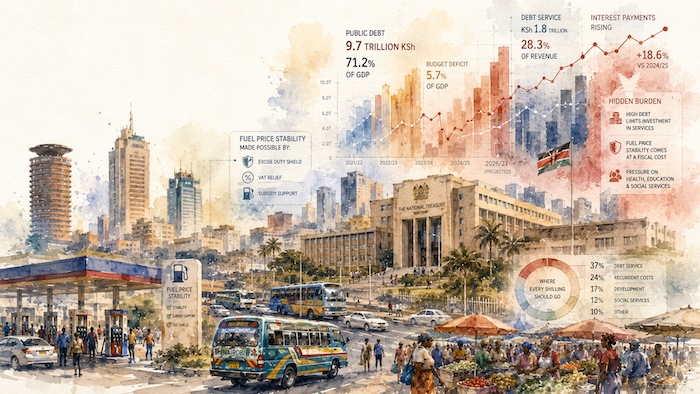
The government’s decision to extend the reduced tax rate on petroleum products for another three months captures Kenya’s governing dilemma. Keeping fuel prices from rising sharply protects commuters, transport operators, farmers and businesses from an external energy shock. It also reduces the risk of another sudden increase in matatu fares and food-distribution costs.
The intervention, however, is not free. Lower taxation reduces revenue at a time when debt servicing already limits public choices. The result is a policy that provides visible relief at the petrol station while adding less visible pressure to the Treasury.
Fuel has become more than an economic commodity in Kenya. Diesel prices feed directly into transport, food, construction and informal commerce. Allowing another severe rise would therefore carry an immediate political cost.
Yet the government cannot indefinitely combine price protection, ambitious development promises, debt repayment and resistance to unpopular taxation. The World Bank expects growth of 4.3 per cent in 2026, below the government’s projection, and warns that higher energy and commodity prices could push more Kenyans below the three-dollar-a-day poverty threshold.
The policy buys time rather than resolving the underlying problem. Kenya’s exposure to imported energy remains substantial, fiscal room remains narrow, and public tolerance for new taxes is still damaged by the Finance Bill conflict of 2024.
What Kenya’s Headlines Are Really Telling Us
1. Economy & Finance
Stability With a Bill Attached
Kenya’s shilling remains notably steady, reducing imported inflation and making foreign-debt planning less volatile. But currency stability should not be mistaken for broad household prosperity.
The World Bank’s lower growth forecast reflects the gap between macroeconomic resilience and lived economic pressure. Agriculture, easing monetary conditions and improved private-sector credit provide support, while energy prices, subdued investment and weaker purchasing power pull in the opposite direction.
The deeper pattern is one of constrained choices. Government can cushion fuel, repay debt, expand programmes or avoid new taxation—but doing all four at scale is increasingly difficult. Every relief measure raises the question of who eventually pays: taxpayers, future budgets, public services or private borrowers crowded out by government financing needs.
2. Politics & Power
A Lead Without Consolidation
Infotrak’s July poll placed President William Ruto at 32 per cent, ahead of Kalonzo Musyoka at 13 per cent and Edwin Sifuna and Fred Matiang’i at 12 per cent each. Eighteen per cent remained undecided. The figures make Ruto the front-runner, but not the choice of a majority.
The governing coalition benefits from incumbency, administrative reach and an opposition divided among personalities, parties and regional bases. Yet the undecided bloc is not empty political space. It may include disappointed former supporters, younger voters resisting established alignments and citizens unconvinced by either government or opposition.
The 2027 contest is therefore developing less as a simple two-sided race than as a struggle over who can convert frustration into organisation. Ruto currently has the strongest machine. His rivals still have the larger collective pool of discontent.
3. Society & Public Debate
The Politics of Prevented Protest
Saba Saba was marked under heavy security, with police checkpoints and roadblocks on major routes into Nairobi’s central business district. The state can present the absence of large-scale confrontation as successful policing. Civic groups can reasonably ask whether preventing citizens from gathering is compatible with constitutional freedoms.
The disagreement reveals a widening divide over what counts as public order. Saba Saba commemorates Kenya’s struggle for multiparty democracy, giving restrictions on the event particular symbolic weight.
Kenya’s public sphere remains energetic—through digital activism, churches, professional associations, media and civil society—but the physical street is becoming more tightly managed. Suppressed protest does not eliminate grievance; it moves it into less visible and sometimes less predictable forms.
4. Youth, Education & Work
Security Before Passion
Young Kenyans are often encouraged to embrace entrepreneurship, digital skills and self-employment. Yet educational choices continue to show a strong desire for predictable professional pathways: accredited qualifications, recognised careers and work that appears less vulnerable to economic volatility.
This is rational in an economy where formal employment is scarce and household investment in education must produce a credible return. Government youth programmes may provide capital, training and visibility, but they cannot substitute for an economy that creates enough productive jobs.
The political importance of Gen Z lies precisely here. This generation is not merely asking to be included in programmes; it is questioning whether the economic settlement offers a believable path from education to independence. That question will shape labour-market policy and electoral politics alike.
Our Take
Kenya’s Calm Is Real, but Conditional
Our editorial assessment: The government deserves recognition for shielding citizens from the full force of an energy shock and for maintaining currency stability during a difficult external environment. Those outcomes protect incomes, reduce uncertainty and preserve economic activity.
But stability becomes fragile when its costs are obscured. Fuel support must eventually be reconciled with debt obligations. Growth claims must be measured against household purchasing power. Political order must not depend on treating peaceful assembly primarily as a security threat.
The Ruto administration’s strongest argument is competence under pressure. Its weakest point is trust. The political challenge is not simply to keep prices, streets and coalitions under control. It is to persuade citizens that the methods used are lawful, equitable and sustainable.
What to Watch Next
Four Signals for the Coming Weeks
- The fuel-support ledger — Watch for clearer disclosure of how the tax reduction will be financed and which budget lines may absorb the cost.
- External financing — New multilateral support may ease borrowing pressure, but its reform conditions will shape future fiscal choices.
- Opposition consolidation — Ruto’s lead partly reflects the absence of a challenger capable of unifying the anti-government vote.
- Police accountability — Investigations into protest operations will test whether oversight institutions can produce credible consequences.
Why Europe Should Care
Kenya’s Stability Shapes More Than Kenya
Kenya is a regional financial, diplomatic, technological and transport hub. Its economic choices affect European investors and development institutions; its political direction influences democratic norms across East Africa. Fuel support, debt restructuring and World Bank financing shape fiscal space for climate adaptation, health, education and European-backed programmes.
The civic dimension is equally important. European governments often describe Kenya as a democratic and security partner. Europe’s useful role is not to lecture Kenya, but to apply consistent standards: support transparent finance, accountable policing, independent media and institutions capable of resolving conflict without closing democratic space.
Quick Decode
Key Questions
Why did Kenya extend the petroleum tax reduction?
To limit the effect of higher international energy prices on households, transport operators and businesses. The measure keeps pump prices lower, but it also reduces government revenue.
Is Kenya’s economy stable in 2026?
Kenya retains important elements of macroeconomic stability, including a relatively steady currency and strong agricultural support. Public debt, energy costs, weak purchasing power and political uncertainty nevertheless continue to limit growth.
What does the Infotrak poll say about the 2027 election?
William Ruto leads individual challengers, but remains well below majority support. The large undecided bloc and a fragmented opposition mean the race remains open.
Why does Saba Saba matter politically?
Saba Saba commemorates Kenya’s pro-democracy struggle. Restrictions on access and assembly therefore carry significance beyond ordinary public-order policing.
Further Reading
Sources Used for This Analysis
-
14 July 2026 · Reuters
Kenya extends fuel tax cut for three more months -
9 July 2026 · Reuters
Kenya economy to grow 4.3% in 2026, 4.4% in 2027 — World Bank -
July 2026 · Infotrak Research
Infotrak Voice of the People Poll -
13 July 2026 · Nation
Ruto leads, but almost one in five voters remains undecided -
7 July 2026 · The Star
Nairobi roads where police mounted checkpoints for Saba Saba
Editorial method: THE KENYA DECODE combines current reporting, original institutional data and editorial analysis. Government statements are treated as political or administrative claims unless independently supported.